

Mirai-si demo improved at Tokyo Game Show 2026 — Smilegate
Key takeaways
- Mirai-si demo shown at Tokyo Game Show 2026
- Smilegate is the publisher; demo focused on UI, 3D models and shaders
- CBT planned before launch but dates and scope are still TBD
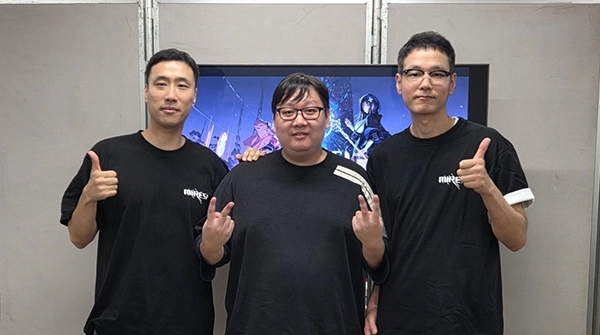
Smilegate brought its subculture title Mirai-si: Invisible Future to Tokyo Game Show 2026 for a second consecutive year, showing an updated demo that visitors could play on-site. The studio presented a build with extensive changes to UI, 3D character modeling, shaders and overall content flow after receiving feedback from last year’s reveal, and core team members Kim Hyung-seop (AD), Jo Soon-gu (PD) and Kwon Se-woong (CD) spoke on development status and next steps at the show.
Jo Soon-gu, the project PD, said the current demo is not identical to the final retail build but was reworked to highlight Mirai-si’s core systems and the team’s intended direction rather than adding new scenarios. Last year’s TGS demo had been assembled to show a full match from start to finish, with narrative beats between characters; this year’s presentation focused on polishing the systems that underlie those moments. The on-floor build ran on PC hardware this time, which let the team introduce keyboard shortcuts and refine UI behavior that had previously been oriented toward mobile. According to Jo, that platform shift and UI rework were part of an effort to address specific complaints raised after the initial reveal.
The headline technical work at TGS centered on 3D model and shader fixes. Jo acknowledged the first public models lacked polish and said the team had already mapped out corrective steps before TGS 2026. Those fixes included correcting camera framing so characters no longer appeared flattened, and tightening control over technical rendering elements that had previously been mishandled. Because the corrective work had been scoped earlier, the team said they were able to apply many changes quickly and iterate in a relatively short timeframe leading up to the show.
Art director Kim Hyung-seop described the shader work as a main focus this cycle. Kim noted that last year’s negative feedback clustered around character modeling, so the team concentrated on reproducing his signature lighting and chiaroscuro-style shading in three dimensions. He framed the challenge as translating his personal visual language—how he handles light, shadow and contrast—into a 3D pipeline with more precise shader control and lighting passes. Kim allowed that the result is not yet final, but he expects further improvements to character models as shader and modeling work continues.
On-unity across diverse character archetypes—wizards, ninjas, cyborgs—the art team applied a visual motif tied to an in-game mechanic called the “stigma.” Kim said they used the stigma as a unifying graphic and thematic element so characters with different concepts still read as part of a single world. After establishing that common visual thread, the team then layered each character’s unique personality and anatomical choices so individual silhouettes and behaviors still stood out. That approach was intended to keep the cast distinct while giving players a consistent aesthetic reference point when scanning party lineups.
Smilegate’s booth presentation included a large LED display showing a playful in-game sequence where characters squeeze through pipes and interact in confined spaces. Jo explained the booth idea originated from the publisher’s business division and was realized in collaboration with the development studio. The LED vignette was designed to convey character body types, conversational quirks and animation details through brief, high-visibility moments—an on-floor way to show off personality and art direction without requiring a deep demo session.
On gameplay, creative director Kwon Se-woong addressed comments that the real-time turn-based combat felt slow or repetitive in the demo. He described the team’s combat intention as slicing the feel of an AOS-style team fight into frame-by-frame, turn-resolved moments—so players can appreciate tactical exchanges at a granular tempo. To reduce perceived downtime, the demo shortens the pre-match wait and attempts to pull the first turn in early so players jump into decision-making faster. Kwon also said the full release will include automated options: sections where player power is high enough will support auto-play to speed clearing, while encounters that require player ingenuity will remain intentionally tactical.
Jo added technical measures aimed at pacing: faster turn cadence through equipment and item choices that increase character speed, and a sequencing design where clustered turn order keeps action flowing once characters’ stats are optimized. For routine or repetitive content, the team plans simple sweep/clear tools so players can avoid unnecessary grind; for harder content, the same systems will leave room for manual input and skillful play. Jo emphasized the team’s intent to strike a balance between low-friction progression for daily tasks and hands-on challenge where players want to test their setups.
On PvP, Jo said the studio thinks real-time PvP as a core feature may not match typical subculture players’ preferences, but the team has implemented a playable system internally. Public plans are to treat PvP as an optional, low-pressure mode—more like friendlies than a mandatory ladder—so players can try it without service-era pressure. The developers intend to monitor user reaction after launch and expand that option only if the community shows sustained interest.
Planned testing and release cadence remain provisional. Jo confirmed that testing will precede a formal launch and that the team is currently focused on lifting overall build quality and increasing content volume to approach test standards. He said final decisions on test scope and specifications depend on ongoing discussions with Smilegate’s business division, so the team could not commit to concrete CBT or launch dates at TGS. On post-launch metrics, Jo said the studio prioritizes active user count over immediate revenue numbers; they view a larger, engaged player base as a prerequisite for rolling out additional services and content expansions.
The demo included feature plans beyond combat and core presentation. The team showed a ‘memento’ system that layers background, voice and sound with illustration to add dimensionality to character storytelling. Kim and Jo discussed an in-game figure/pose feature: rather than force exhaustive animation collection, they’re leaning toward light achievement-style rewards—specific animation frames or poses that players can obtain without full-collection pressure. The figure system may include modest collecting or light achievement mechanics, but designers are guarding against heavy collection fatigue by keeping R&D focused on low-burden rewards players can display.
Why it matters
Takeaway: Smilegate’s Mirai-si team used two straight years at Tokyo Game Show to convert last year’s visual and UI critiques into concrete fixes—camera framing, shader passes, PC-focused UI shortcuts, pacing tweaks and a small, approachable figure/achievement plan—and they’re moving toward a closed test window once build quality and content volume meet the business-side specs. For players that noticed last year’s rough edges, the TGS 2026 demo gives specific points to re-evaluate: shader-driven lighting, tighter camera framing, keyboard-friendly UI on PC, and an auto/quality-of-life plan tied to combat-power thresholds.
Original source
Google News: GameMeca